


Pyrite, Chalcopyrite, and Peacock Ores
We all know pyrite better as "Fool's Gold." This shiny, metallic looking mineral earned that reputation because it looks a hell of a lot like gold. We will give tips on how you can tell the difference between pyrite and real gold below. First, though, here is our collection of pyrite, chalcopyrite, peacock ore, and realted minerals. FYI we find a lot of chalcopyrite & pyrite crystals in the lowlands, so Scotland is a good producer of naturally shiny minerals.
You also get gold there. Just don't be fooled.


How do you tell the difference between fool's gold and real gold?
There is a really easy way to quickly tell the difference between fool's gold and real gold. Fool's Gold (Pyrite) is brittle and hard. Gold is softer and will bend before it breaks.
Old Western films showed cowboys checking the gold was real by biting into it. They were checking for hardness! Just don't bite too hard in case it is pyrite.
You have to be careful, though. We all know that you can paint Lead with golden paint and ,since it is also soft, you might never know the difference without an expert eye... and you don't want to bite it!
What if the Nugget is Too Small?
If the sample of Pyrite or Gold is too small to prod with a pin, then you have other options.
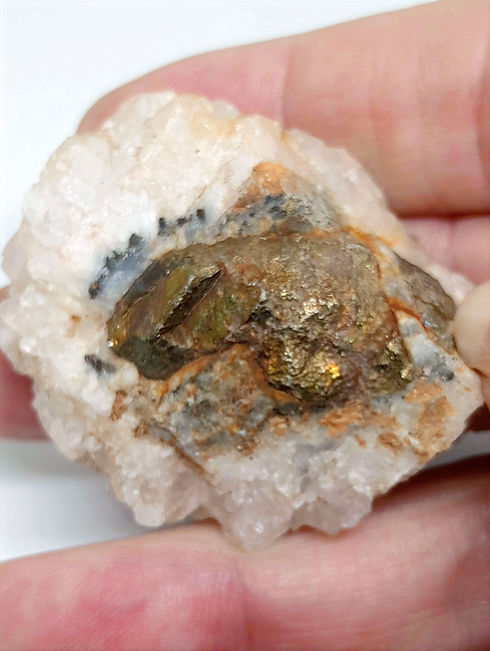
PYRITE is a paler colour than gold. It might well have different colours through it from different angles, in which case there maybe a touch of chalcopyrite in there. It is brittle, can crumble, and occurs anywhere that you find sulfide deposits.
CHALCOPYRITE is often tarnished in reds, greens, purples, or yellows. We have seen a nice orange one, too. Although not true Bornite (Peacock Ore), Chalcopyrite can take on those irridescent colours.
GOLD is always gold. Just like your ma's golden wedding band. You don't question what it is when you see it. You just know.
The only exception to the gold-is-gold rule is when gold is riding an iron horse. Then it might have iron and a little rust attached.
When identifying fool's gold or real gold, location is quite important. While gold is much heavier than water, pyrite is not. Little bits of pyrite even float. If you found it in a shallow hole, it's likelier to be fool's gold. If you found it in a deep one near bedrock, then you may just have the real thing.
So What Actually Is Pyrite if it's Not Gold?
Pyrite is an iron sulfide mineral, specifically (FeS2). It is quite remarkable in that you will find pyrite crystals in sedimentary, metamorphic, and igneous rocks. Anyone can pyrite. It's a free-for-all.
Known for being almost-yellow, pyrite looks like you are looking at gold through a grey glass. It is further remarkable due to the forms it takes. Not only does it appear everywhere, but it also comes in miniscule form, hexagonal crystals, and beautiful cubes (as well as other forms).
Pyrite has a noticeable streak that is a greenish black. We will add a blog on how to conduct a streak test in future. For now, find a mug in your cupboard which has an unglazed bottom, or use the underside of your toilet (cistern) lid. Try to draw on it with the mineral sample. Pyrite will leave that greenish-black streak. Gold is always gold. Even in a streak test.
Pyrite was named for the Greek 'Pyr', which means 'fire', purely because it makes sparks when you hit it with something metal. I have not tested this myself yet. Cannot confirm but that's what the internet says. I am still hurting from the time I hit the copper with the hammer. I am not doing that again.
You can learn more about iron pyrite on sites like Geology.com and of course on our very favourite site, Mindat.