


Famous Scottish Rock Hunting Locations: Dunure

Thinking of going rock hunting in Scotland? People have been hunting cool rocks at Dunure for generations. However, the area is protected by SSSIs (two of them) so you have to be very careful about where you hunt.

<This article contains Amazon links in the final paragraph>
This is our second trip to South Ayrshire which has multiple locations for rock hunting. We previously covered Ayrshire in Galston when we were talking about Burn Anne and its famous chalcedony seams. You can read about Burn Anne here, otherwise stay tuned for Dunure.
For the moment though, let’s talk about Dunure.
Dunure is a Fishing Village
Dunure has a history of fishing stretching back as far as anyone can remember. It also has its own castle, which is a big draw to tourists all year round. In summer it gets so busy that you might find yourself fighting for a parking space even though there are loads of them at the castle. Parking is (at the time of writing) free, but I don’t think they allow overnight parking, correct me if I am wrong in the comments please.
Dunure Castle
Dunure Castle is the main draw for tourists. It is on a clifftop, still accessible, and has picturesque views the likes of which you never saw before. You have Ayr north along the coastline about five miles and Culzean Castle further south along the coast, should you be a castle fanatic.
Dunure Castle has appeared in “Outlander”, Dunure is one of the locations for filming.
Historians estimate that the castle was erected in the 1200s. What I have found writing about other places like this in the past (used to write town articles for Five Minutes Spare) is that the castles and the churches of old tended to be built upon structures that were already there. So even though the castle dates to roughly 1200, it’s highly possible that it was built on the site of a lookout post or a stately home.
The castle at Dunure belonged to the Kennedy clan. One of their number married King Robert III, so they were a pretty important family. The castle once had a great hall, a prison, its own chapel and a kitchen range.
Notable moments in the castle’s history presented as bullet points because we are here for the rocks, not for the castle, but it is still fascinating:
Mary Queen of Scots (the one who got murdered by her cousin Elizabeth) stayed here for three nights in 1563.
In 1429 there was a meeting between a Campbell and a MacDonald here, the MacDonald was murdered and the Campbell was executed as a result. The beef between the Campbells and the MacDonalds was very real.
One of the Kennedys was involved in an illegal land grab for estates in Dumfries and Galloway (not that far south), the castle was stormed by a different Kennedy, who also wanted control. There are assassins in this story. Undiscovered Scotland tells it well.
This story ends with the Abbot Alan Stewart being tricked into coming to the castle only for the reigning (Gilbert) Kennedy to roast him over an open fire in the castles infamous ‘black vault’. If a Kennedy wants to roast you, please say no.
The castle fell into ruin in the late 1600s and large bits of it were used as stones to build other things. There are also giant chunks of masonry on the beach below.
Now that the castle’s history and an understanding of why this village is here has been established, we can move on to the rocks. That was an accidental history lesson. I just find Scottish and clan histories completely fascinating.
Tips About the Rocks of Dunure
Dunure has some fantastic stones. However, much of the gathering of said stones happens on the beach. There are rules against collecting on the beach in the UK. I have spoken to other rock hunters more senior than I am and they said that if you collect below the tideline, then you are collecting from the sea and not the coast. I don’t know how I feel about that. I advise all of you to keep yourselves right by collecting along the coast but from the mouths of streams and rivers. These pebbles have been washed down from the high places. It is a more ethical method of collecting and you won’t get arrested.

Another key point about Dunure. I have met and spoken with fishermen and divers who have been off the coast there. One of them told me that there is a huge line of what he thought was amethyst on the sea floor out there.
A third person told me that the flinty, chalcedony type material you get there forms some of the sea floor off the coast, too.
Unlike areas of Scotland where the coastline is in jeopardy, Dunure has waves washing the rocks inwards, instead of outwards. This makes it a much more ethical place to collect than say, for example, Lunan Bay, which needs the sand dunes to protect it. Dunure is craggy, rocky, and full of cliffs.
Types of Rock to Look For in Dunure
There are a bunch of rocks which I will not mention so don’t come at me. I don’t have infinite knowledge, just what I have studied already. Every trip sees us with a new rock to ID when we come home. But here’s what I know.
Jasper

You will get the most beautifully bright red jasper you have ever seen in your life here. It is easily recognisable due to the brightness of the reds. However, this location also has other colours of jasper stone. Once you are comfortable hunting the reds, look out for yellows, oranges, and even greens.

Porphyry
There are lots of rocks with what look like little lines on them. These lines were crystal impressions but the crystals are worn away. These are commercially sold as “Chinese Writing Stones” because the lines can resemble Hanzi script. Personally I don’t like the term, I think it’s bordering on racist or xenophobic.
Amygdaloidal Vesicular Basalt

You will find lovely galaxy stones at Dunure. They are basalt, black to grey, and have little vesicles (holes) filled with other material on them. The other material in Dunure is often a pink potassium feldspar, calcite, or quartz. Some have little agates in. This is the material which was created during the old volcanic era, when the lava cooled slowly to form the black basalt. The agates formed later. This is the material that the agates come from.
These are often called “Galaxy Stones” because they look like space with planets in it.
Agate

The ocean erodes the softer basalt shells away from the galaxy stones and you might be left with Agate, Chalcedony, Quartz, or Jasper.
Agates form in specific patterns. The main colours for this area are pink and grey. We find more waterline/fortification agate here than anything else. Look out for rocks with little bullseyes on them, these are eye agates. You also have a lot of green and red mossy material here.

Chalcedony
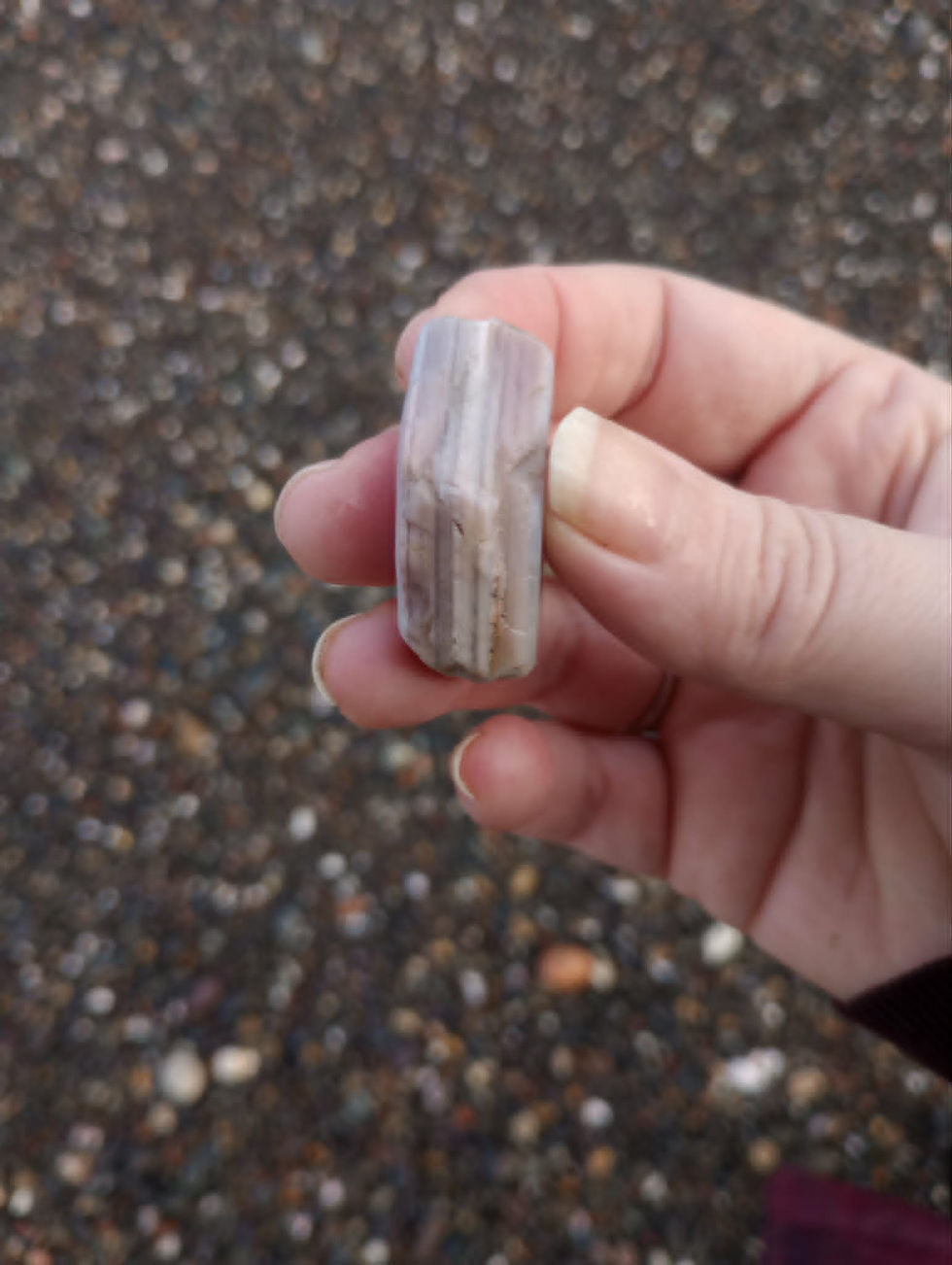
You can’t have an agate without layers of chalcedony. The chalcedony in Dunure tends to be pink, grey, or white, although we have found lots of other colours. The white is easy to mistake for quartz but if you place it next to a piece of known quartz you will see that the chalcedony has a slightly blue hue to it.
Chalcedony can be multiple different colours. Purple, pink, grey, red, and green are the most common in this location.

Flint

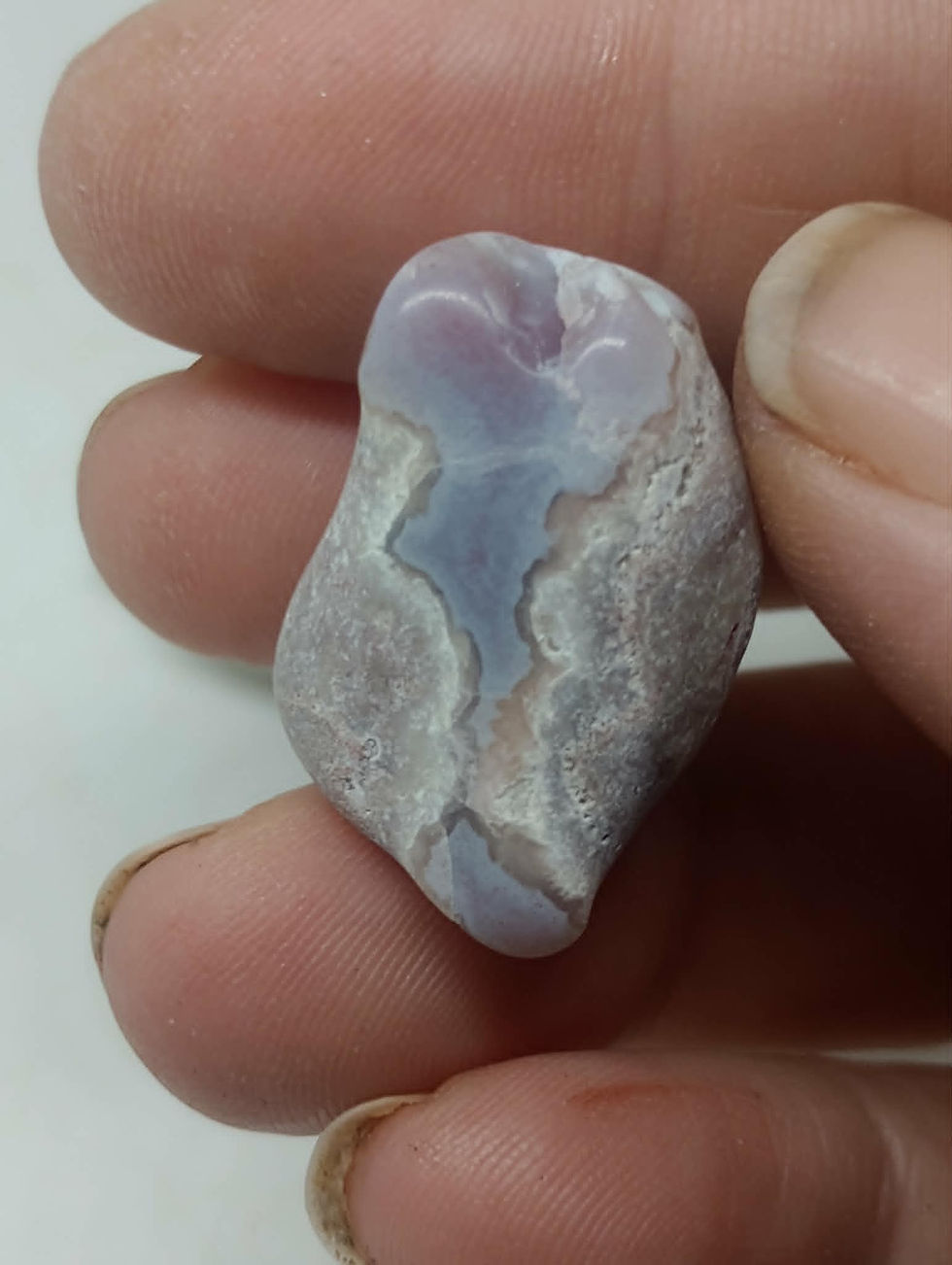
The flint material you find here can be very similar to chalcedony. There are red hued and blue hued flints, although I also found black one trip. The picture opposite is one of the bluer flints. When I say blue or red, I am referring to the outside. Most of them look like the picture below on the inside.
These are easy to mistake for agate to the untrained eye. The difference is that these don’t have any recognised agate patterns, which you can learn about in our previous blog.

Quartz
You find this all over the place. If it is white and you can’t smash it with another rock, it is likely quartz. Quartz can also be iron stained in this area. You might find it with yellow, orange, and particularly deep red colouring in this area.
Calcite
We once found a whole chunk of calcite here in the sea. Plus there is another piece which was a calcite formation with a coating of hematite.
The interesting thing about the calcite here is that it shouldn’t really exist. Calcite and salt water don’t go very well together. It will eventually erode it away. However, the sea is always eroding bits out of that lava flow and a clean break in a rock might present calcite that hasn’t been exposed to the water for long.
I’m rambling about rocks and shall now stop. Shoutout to the opalised shells you can find there in the tide pools, too.
The SSSIs at Dunure
The biggest issue with collecting at Dunure is that you need to know where the SSSIs are. These are Sites of Special Scientific Interest and it is very, very illegal for you to remove material from these areas. Obviously with its offshore bars of mineralisation and its precariously perched castle, Dunure has a long history which we want to preserve.
I always advise you to check the SSSI map before you go anywhere. In this case, the SSSI starts at Greenan Castle in Ayr and ends a couple of beaches north of Dunure. It then starts again after Dunure Castle and continues all the way around to Culzean Castle. If you are caught picking rocks in those areas it is feasible that you could get into trouble. Nature Scot are not shy about prosecuting people who destroy important sites.
Please don’t destroy Dunure. It is one of my favourite places in the whole world.

Check the SSSI map before you go and fix in your mind where you cannot collect from. I would normally link the map but the site has it under review for updating right now. You can search the register for Dunure, too.
Other Important Dunure Info
Make sure you buy a coffee or a lunch at the Harbourside Café. They are lovely people and told me about three years ago that I was welcome to take pictures of the shop for this blog. Then I didn’t write the blog. The pictures are long gone… so we have a shoutout instead. The mocha is excellent and it is important to give back to the communities which help us rock hunt. Read more about ethical rock hunting practices on our previous blog.
If you park on the front you only have two hours. Park at the castle and you can stay all day.
Looking for somewhere to stay nearby? Craig Tara the holiday park with the caravans is about 2 miles north. They are reasonably cheap especially in January – February time.
I have a vested interest in Dunure. As I mentioned, it’s one of my favourite places. It has a calm, relaxed vibe with lots to see and do for such a small place. There are people like me who are fiercely protective of the land and of the areas we collect from. This means collecting rubbish, not over picking, and being aware that other rock hunters are likely to be there with you.
Be nice to each other out there. There are plenty of rocks for everyone.

Further Reading
If you want to buy things to help you identify rocks then fair play to you. If you use these links to useful books and rock id products then I earn a small commission. The small commissions help fund TSC and makes sure my bills get paid. Otherwise I just write these for free. One day I will write a book of my own about it.
In the meantime, I recommend these for rock ID:
The Pebble Spotters Guide is fantastic and has excellent guidance on beach collection. You can also join their Facebook group to show off your finds.
If you don’t want to carry a book and get it wet and sandy then you can use this online e-guide called What’s that Rock or Mineral. It gets the highest rating of the other books that I am looking at though I have never used it personally.
You can use the Mohs hardness of rocks to identify them. For example, all the quartz minerals have a hardness of 7 – which means jasper, chalcedony, quartz, amethyst, etc. These hardness testing files might be of use to you. I also really like the look of this mineral ID set which comes with example rocks you can test.
If you want to identify rocks using a streak test, you can buy a streak plate, too.
And if you really want to help us out then you can Buy me a Coffee through my own website, here.
This turned into a 2.1k word article. I just wanted to talk about rocks.

$50
Product Title
Product Details goes here with the simple product description and more information can be seen by clicking the see more button. Product Details goes here with the simple product description and more information can be seen by clicking the see more button

$50
Product Title
Product Details goes here with the simple product description and more information can be seen by clicking the see more button. Product Details goes here with the simple product description and more information can be seen by clicking the see more button.
$50
Product Title
Product Details goes here with the simple product description and more information can be seen by clicking the see more button. Product Details goes here with the simple product description and more information can be seen by clicking the see more button.


Comments