


What Does Mohs Hardness Mean?

Has someone asked you to perform a hardness test on a cool rock you found? If you are seeking to have your cool rock identified, then performing a hardness test is a good tool you can use to give a better educated guess on what the rock or mineral specimen is.
<This article contains links to Amazon products but there is no obligation to buy anything>

This blog explores the Mohs hardness rating system and will give you insight into how you can use hardness testing yourself to identify rocks of your own.
What is Mohs Hardness?
The Mohs hardness scale is named after the scientist who invented it. Friedrick Mohs, a German mineralogist who had a steady career surrounded by rocks. He modernised mines in his area, made trips to the alps to hunt for rocks, visited mines all over Europe and generally did a bit of everything. You can read more about his fascinating life and work here, courtesy of the Science History Institute.
Mohs invented a scale by which he could measure how hard each known mineral was. This ultimately helped other gemmologists to differentiate between rocks.
The best way of thinking about the Mohs hardness scale is to go back to our gold panning roots here at the Stone Circle. When old timers in the wild west dealt in gold coins they would bite into them to make sure that they were soft (because gold is soft) and that they were gold all the way through (because lead is also soft and can be painted in gold).
On the other hand, if you bit into a diamond, you would break your teeth.
And everyday objects that you use all the time will have different hardnesses. For example, your steel nail will have a hardness rating of around 6.5, whereas stainless steel knives are around 5.5. Glass windows are around 5.5, too. Wood has a hardness around 2 and plastic from 2-2.5, harder if it is thicker.
Let’s look in detail at where some known minerals fall on the scale to give you a better idea of how Mohs hardness ratings work.

The Mohs Hardness Scale Looks Like This:
Talc or Clay – Very Soft – You can squeeze it between your fingers, and it will break apart.
Amber, Gypsum or Selenite – Still very soft – You can scratch it with your nails and leave a mark.
Calcite or Coral – Calcium Carbonate – Reasonably soft – You could easily break it up using another rock. An old fashioned copper penny has a hardness of 3.5.
Fluorite and Pearl – You can scratch it if you use a stainless steel knife, but it is not necessarily a soft mineral.
Apatite or Turquoise is five, stainless steel is around 5.5. Glass is around 5.5, too. This is about halfway on the Mohs hardness scale.
White feldspar (orthoclase), zircon crystals, and zoisite all come in at hardness 6. Sandstone, Granite and basalt, and a steel nail will typically fall between 6 and 7, too.
All the quartz minerals have a hardness of seven. These are considered hard. They will smash with a hammer but need force. All the quartz minerals include citrine, smoky quartz, amethyst, rose quartz, and the others.
Topaz is the main crystal which is harder than quartz.
Both Sapphires and Carborundum are considered to be a 9 on the Mohs hardness scale. Carborundum grits are what you use in your rock tumbler to polish rocks.
Diamond is a 10 on the hardness scale but modern science has created minerals which are harder even than diamond.
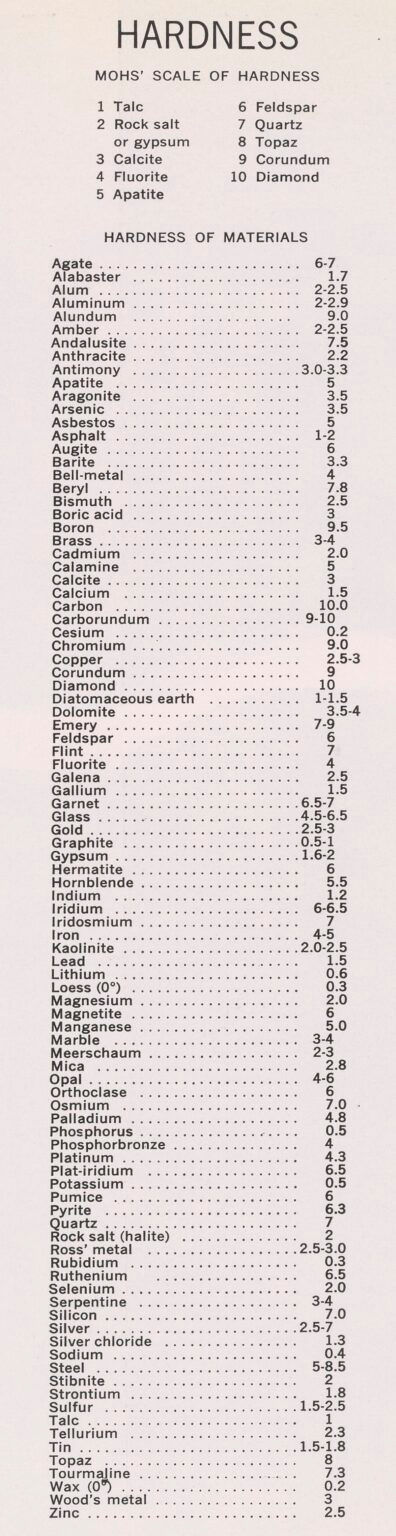
Which Minerals are Harder than Diamonds?
So, when the list above was created, diamonds were the hardest known mineral. However, humans being humans, we have since created mineral materials which are harder even than diamonds.
Some minerals which are harder than diamonds on the Mohs scale include Lonsdaleite, Wurtite Boron Nitride, Q-Carbon, and other nano-carbon materials.
How do You Perform a Hardness Test on Rocks?
The easiest way to perform a hardness test on rocks is to find minerals which have a known hardness and use those to see if you can scratch your mystery mineral.
For example:
If all quartz rocks have a hardness of seven then they will scratch everything except 8/9/10 hardness rocks.
If a stainless steel knife is 5.5 and can’t scratch your mystery mineral, then the mineral must be harder than glass and stainless steel.
If a piece of glass can scratch your mineral, then it must be of hardness 1-5.
We use hardness testing to narrow down the options of what your mineral might be. This method of rock identification is best used in conjunction with other rock ID tests for best results.
Can you buy a Mohs hardness testing kit?
You can pick up a Mohs hardness tester on Amazon. You can get them at three different price points, depending upon what you need them for. We tend to just use objects of known hardness such as a quartz point or a stainless steel knife.
Small Mohs Hardness Testing Kit for Field Use
If you are looking for a hardness testing kit for out in the field rock hunting, then consider a mineral and unglazed porcelain streak test kit. This Mohs hardness testing kit from Landical comes with 9 minerals which you know the hardness of alongside the unglazed ceramic which you can compare with your findings. It is technically two kits in one since it helps with both streak testing and hardness verification.
Hardness Testing Kits for the Rock Studio
Up a price point is this 6 pack of Mohs hardness testing files. These come with complete instructions on how to use them. Each file is a specific hardness, and you can use them to see if they scratch or damage the rock you are trying to identify.
Be mindful that you might damage the rock performing a hardness test. It is best to perform it on rough rocks rather than on polished faces.
Professional Mohs Hardness Testing Kit
If you are a professional rock enthusiast, gemmologist, jeweller, or otherwise have a special need for expert tools, then you can go up a price point again and get the top of the range equipment.
This 4 pack of Mohs hardness testing files from Ericat is made for industrial use. Use these for pro mineral ID.

Other Tests Used in Mineral Identification
Mohs hardness testing isn’t enough on its own to tackle rock identification. There are a number of other tests employed by geologists to determine what a rock is. You can use a specific gravity test, choose streak testing where you draw on unglazed porcelain and see what colour that streak is.
Geologists examine the lustre since certain minerals are waxy looking or may even take the density of the mineral into account. You can read more about mineral identification on our previous blog post: “Where Can I Identify a Rock I Found?”
Further Resources for Rock Identification
We find the best place to get a mineral id is on Facebook or Reddit. However, if you want to teach yourself then these further resources for rock identification will help.
Books
Amazon has a whole host of books on identifying rocks and mineral specimens. You can view the full list here. A special shoutout to the Pebble Spotter’s Guide – National Trust Edition, which has a massive online following.
Courses
We mention courses because a short geology course truly helps with identification and you can do one for free, through the Open University. You can find all the details here.
Websites
The mineralogical Society of America have a thorough, detailed, and completely free online mineral identification key you can find here.
Of course you should bookmark us for more mineral ID tips: www.thestonecircle.co.uk/blog
The Natural History Museum has another great resource for identifying UK rocks.
Enjoyed the Article?
You can support your favourite writers by following them on social media. Sure, we love it if you buy us a coffee or buy a book, but not everyone has that kind of cash. Find Katriona Macmillan (@KatrionaWrites) on Facebook, Instagram, and TikTok for free work that may or may not tickle your soul. Support your local creatives to help us keep filling the world with poetic nonsense.




Comments