


5 (More) Types of Crystal You Can Find in Scotland

We already covered five minerals which you can find in Scotland. These were pretty abundant and, weirdly, attracted a bit of anger. Apparently, we missed too many out. Who would have thought it? What with the list only being five crystals long.

So here is our additional blog post regarding five (more) crystals that you can find in Scotland. We obviously won’t get through the exhaustive number of minerals you can find here, but we can, at least, give you budding rockhounds another glimpse into what you can find in Scotland.
Please don’t come for us in the comments. We are writing as fast as we can.
The 5 Other Crystals You Can Find in Scotland
Article one covered Quartz, Jasper, Chalcedony, Amethyst and Calcite. This time we will go a little deeper.
1 – Mica
The Scottish Highlands are full of micaceous schist. It erodes out of the ground along the northern mountains, the result of constructive plate tectonics. This produces some of the world’s oldest rocks. The Lewisian gneiss, for one. The Highland fault has a noticeable starting point about halfway up Loch Lomond. There is a geo walk along the eastern shore where you can physically see the change in the rocks.
Back to the mica.
Mica includes many individual types of rock. You can have the green coloured chlorite, the golden muscovite, the black biotite, and a whole host of others. These are the three we know because these are the three that we find up north. Almost every stream is rich in metamorphic mica schist. Every river has rocks so sparkly that noobies frequently confuse them with gold. It’s gorgeous stuff.
But it’s not just pretty. Mica has a variety of real world uses. It forms in platelets which easily come apart into thin sheets, giving this type of rock the name sheet silicates, since they are a silica based rock. It is used in making medicine, in insulation, and in making electronics.
You can find mica all over the highlands or you can buy your mica from us, usually with garnets in.

2 – Silver
There is silver in Scotland. What we know from gold panning is that there were the Alva silver mines in Stirlingshire. Any old pictures we have seen of silver from Scotland has been vein silver, i.e. it looks like dendrites or the form of tree roots. However, a bit of light research shows that there are more than just those silver mines in Scottish history.
Silver Glen in Clackmannanshire is the biggest mine for silver in Alba. Near the town of Alva, this mine was discovered just as the Jacobite uprising began. At one point there were 40 tons of silver ore drawn from this mine and stored in barrels at Alva House, near the Ochil Hills.
Scotland also plays home to the Hilderston Silver Mines, known as King Jamie’s Mine. This mine was worked in the early 1600’s in search of silver to make the crown jewels with. So today we learned that it is not just Scottish jasper that makes up the crown jewels, but also Scottish silver.
So, there is silver out there. The best way to find it is to pan for it in rivers or burns near old mine sites on the off chance they missed some. We haven’t tried yet. Also watch out for the beercanite. Melted aluminium looks suspiciously silver in the right light.
3 – Garnet
We mentioned garnets when we were talking about mica schist and gneiss earlier because garnets fall into the category of metamorphic rock – or most of the time they do, anyway. It’s a bit complex. The short answer is that if you find mica-rich-rocks, then you should check them for garnets.
Scottish garnet is often eroded and largely not of gem quality – but still pretty. They can appear as orange, rusty-looking dots in the schist or gneiss. If you are up in the Highlands and the sand looks a bit red, then we recommend you take a closer look. It might be garnet.
Let’s not forget Ruby Bay, either. Legend has it that you traditionally find garnets on the east coast of Scotland, but we have found them both centrally and in the western sea lochs. They are everywhere. If you have ever gold panned in the Highlands and been left with little red crystals at the end, that was garnet. They can be very heavy depending on what rock initially caused them to form.
You can buy the occasional garnet in a gem pod or still in the schist from the Stone Circle. You can also find them yourself anywhere north of Glasgow. You should probably read our article about Ruby Bay before you go there. It is an SSSI so if you are collecting you will need to know where you can and cannot go. We avoid it altogether. There are plenty of garnets in non-protected areas.

4 – Agate
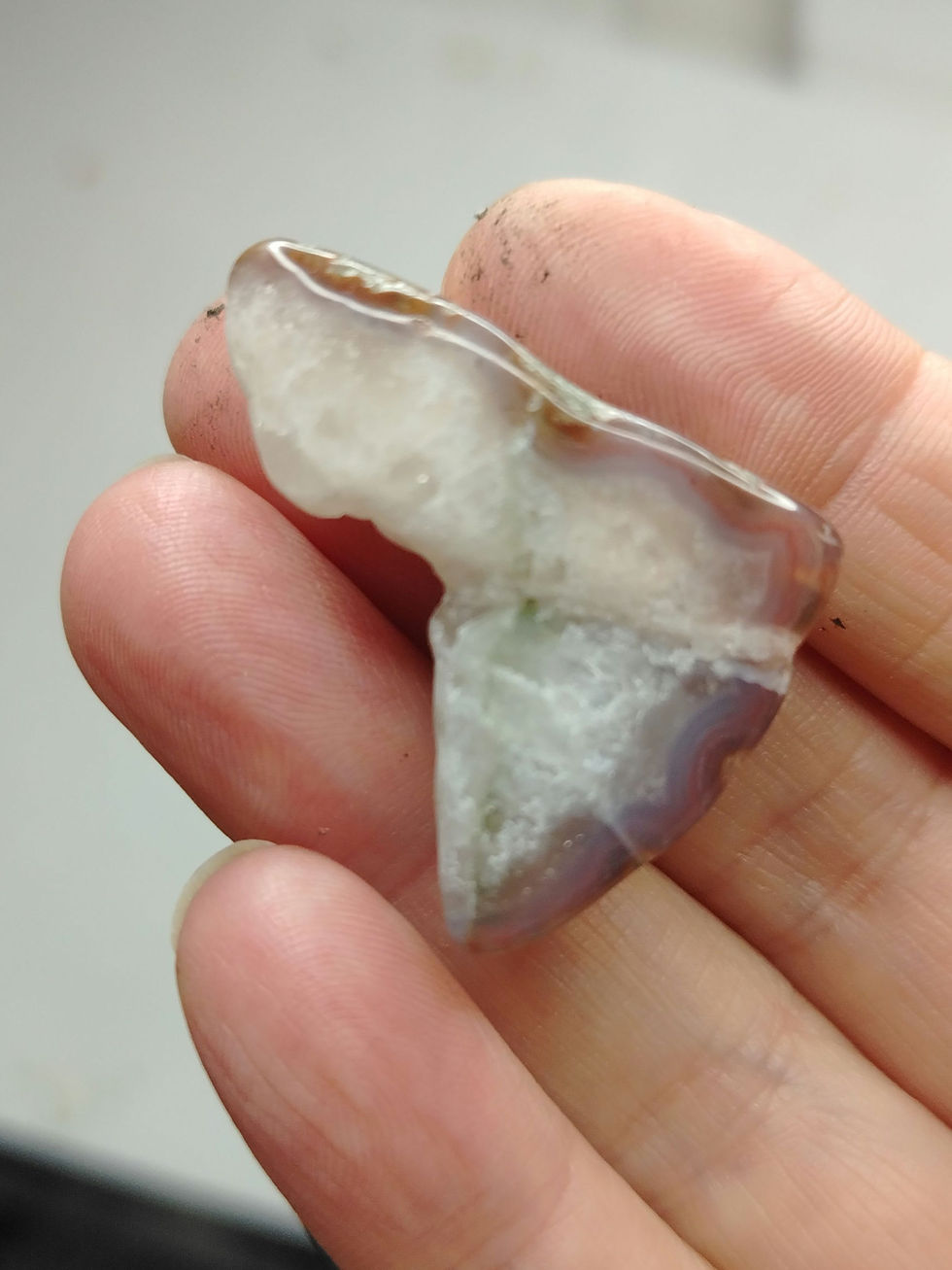
Scottish agates are some of the most sought after rock hunted in the country. Technically, agates are a combination of minerals rather than a crystal. They contain chalcedony, occasionally quartz, iron oxides and other minerals which colour them, and even other rocks like calcite, amethyst, flint and rhyolite. Since agate isn’t really a crystal, you can have flint and rhyolite for free.
Scottish agates come in all shapes and sizes. Most commonly we find banding, fortification, waterlines, eyes, tubes, and quartz pockets. We have seen spotted agate, agate wrapped in a band of red like a ribbon, plume agate, moss agate, and everything in between.
Scotland has a host of agate treasures out there to find. Just remember to double check that SSSI register to stay away from protected areas before you go looking.
5 – Gold
If you follow The Stone Circle, then you may or may not already know that we have our roots in gold panning. Katriona started panning in 2017 and this quickly led to an interest in geology and rockhounding over gold. When it comes to Scottish gold, we know all the legends and have heard all the tall tales.
Yes – gold is a crystal. It can form as pronounced crystals. It can form as cubes, octahedral shapes, it can be shaped like the bronchial passages of the lungs in dendrites… it has many forms. Although commonly in Scotland you will find it in the shape of a blob.
The gold erodes out of the earth in the water, and the water makes it into the blob shape of Scottish gold that we know and love. Gold panners and metal detectorists are responsible for much of the Scottish gold produced, except for the mine at Cononish. You can read about the Douglas Nugget courtesy of National Museums Scotland. It is the biggest nugget ever found in Britain weighing an astounding 85.7 grams. It is worth over £50,000 on a bad day. It is from Perthshire… not Douglas.
Read more about how to identify gold here or read about paydirt to try gold panning for yourself.
Alternatively, get out there and give gold panning a go yourself. You can pick up your own gold panning kit on Amazon to get you started. There are gold bearing areas you can visit in Wanlockhead, in Tyndrum, and up North-north in Suisgill. In the summer time, the Museum of Lead Mining will even give you beginner's gold panning courses. The only rule is that you have permission from the landowner.
Happy hunting!

Where to Find Scottish Crystals, Rocks, and Minerals?
You can depend on The Stone circle to find Scottish crystals that are legal, safe, and ethically sourced from non-protected areas. You can choose to go out and hunt them down yourself, too. If that is how you wish to proceed then you should definitely follow the Stone Circle’s rock blog. Subscribe at the bottom of the page or read more about where to rock hunt in Scotland in our blog category on rockhounding, here.




Comments